Warning sign
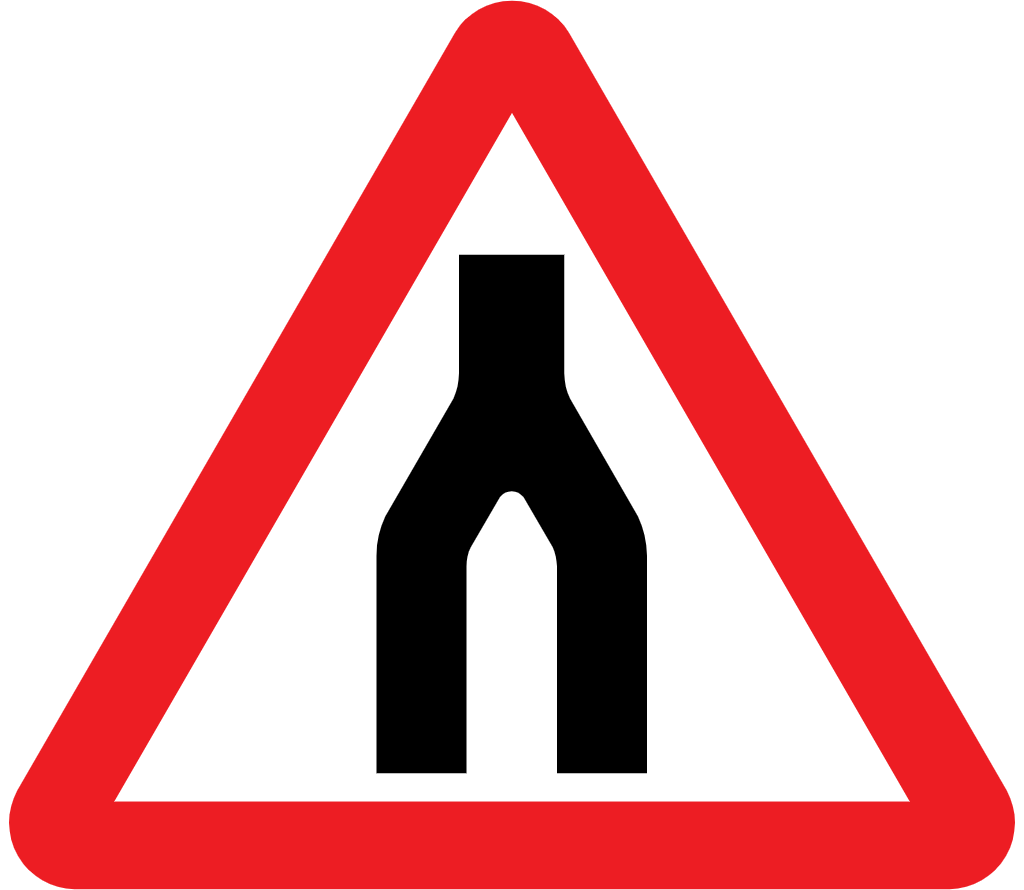
Dual carriageway ends sign
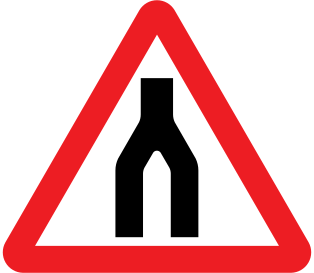
What does the Dual carriageway ends sign mean?
Warns that the dual carriageway ends ahead. Traffic will soon be coming towards you on the same road.
What it means
The central reservation ends ahead and the road becomes a single carriageway with two-way traffic.
The two lines show the separate carriageways joining into one road.
Finish any overtaking before the end and get back into the left lane. From here, oncoming traffic is on the other side of the road with nothing between you.
Where you'll see it
Shortly before a dual carriageway becomes a single carriageway.
Rules to know
The sign warns of the end of a dual carriageway.
Know Your Traffic Signs, p. 11
On a two-lane dual carriageway you should stay in the left-hand lane and use the right-hand lane for overtaking or turning right.
The Highway Code, Rule 137
Common mistakes
Mistake: Starting to overtake just before the end.
Instead: The extra lane is about to disappear and oncoming traffic will be next to you. Finish overtaking early.
Test yourself
Recalling the answer helps it stick. Pick an answer to see how you did.
Question 1 of 2
What does this sign mean?
Ready for more? Take the Warning Signs Quiz
Download this sign
© Crown copyright. Free to reuse under the Open Government Licence v3.0, as long as the sign is reproduced accurately and not in a misleading context.
Related signs
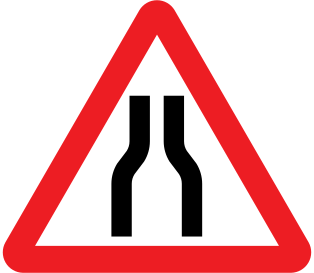
Often confused with
Road narrows
Warning sign
Both lines bend in: the road narrows on both sides.
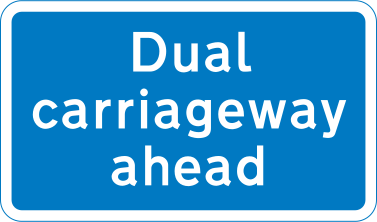
Opposite
Dual carriageway ahead
Information sign
A dual carriageway starts ahead.
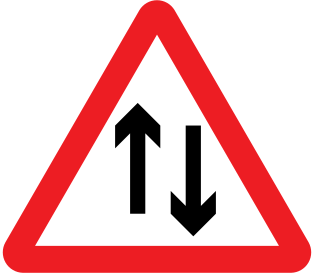
Used with
Two-way traffic
Warning sign
Often follows: two-way traffic on the road ahead.
More warning signs
All warning signs
Sources
- Know Your Traffic Signs (Department for Transport, Sixth edition, 2023), Warning signs, p. 11
- The Highway Code, Rule 137
Sign image: Department for Transport, Traffic sign images (diagram 520). © Crown copyright, reused under the Open Government Licence v3.0.
Last reviewed 6 October 2026. This page explains the sign in our own words; for the full rules, see The Highway Code. How we source and check content