National speed limit: is it 60 or 70?
The national speed limit sign has no number on it, so drivers often ask whether it means 60 or 70. The answer depends on two things: the type of road and the vehicle you're driving.
For cars and motorcycles, it's 60 mph on a single carriageway and 70 mph on a dual carriageway or motorway. This guide explains how to tell the two kinds of road apart, and which vehicles have lower limits.
By Bikash Thapa, founder and editorPublished
Drafted with AI from the Highway Code and Department for Transport sources, then checked and approved by Bikash Thapa. How we write guides
The short version
- For cars and motorcycles, the national speed limit is 60 mph on a single carriageway and 70 mph on a dual carriageway or motorway.
- A dual carriageway is a road with a central reservation separating the two directions of traffic. The number of lanes doesn't decide it.
- Two lanes each way with only painted lines between them is a single carriageway, so the limit for cars is 60 mph. One lane each way with a central reservation is a dual carriageway, so it's 70 mph.
- If you're towing, or driving a van that isn't car-derived, the national limits are lower: 50 mph on a single carriageway and 60 mph on a dual carriageway.
- The limit is a maximum, not a target. On a narrow country road where the national limit applies, a safe speed may be much lower.
60 or 70 at a glance
Where you see the national speed limit sign, find your vehicle in the table, then check which kind of road you're on.
| Vehicle | Single carriageway | Dual carriageway |
|---|---|---|
| Cars and motorcycles, including car-derived vans up to 2 tonnes laden | 60 | 70 |
| Cars towing caravans or trailers | 50 | 60 |
| Motorhomes up to 3.05 tonnes unladen | 60 | 70 |
| Motorhomes over 3.05 tonnes unladen | 50 | 60 |
| Vans and other goods vehicles up to 7.5 tonnes laden | 50 | 60 |
| Buses, coaches and minibuses up to 12 metres long | 50 | 60 |
The Highway Code, Rule 124
What makes a road a dual carriageway
A dual carriageway is defined by what separates the two directions of traffic, not by how many lanes it has. Look for a central reservation: a grass verge, a kerbed strip or a barrier running between the two sides of the road.
A road with two lanes each way and only painted lines down the middle has no central reservation, so it's a single carriageway: the national limit for cars is 60 mph. A road with one lane each way and a central reservation is a dual carriageway, so it's 70 mph.
A dual carriageway is a road which has a central reservation to separate the carriageways.
The Highway Code, Dual carriageways (Rules 137 and 138)
In law, a central reservation is any land between the two carriageways of a road, or any permanent work in the carriageway, other than a traffic island, that separates traffic moving in one direction from traffic moving in the other.
The Traffic Signs Regulations and General Directions 2016, Schedule 1, Part 1 (central reservation, dual carriageway road)
A single carriageway can have three, four or more lanes. Where a single carriageway has four or more lanes, use only the lanes that signs or markings indicate.
The Highway Code, Rules 135 and 136
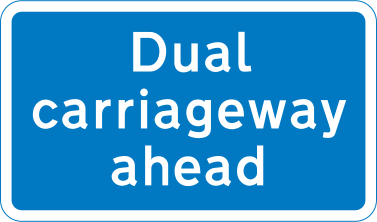
Dual carriageway ahead
Road sign
A dual carriageway begins: 70 mph for cars
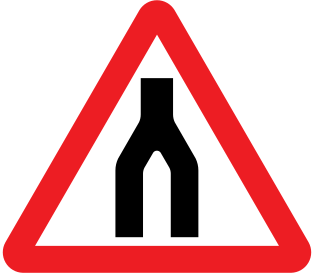
Dual carriageway ends
Road sign
Back to a single carriageway: 60 mph for cars
What the national speed limit sign tells you
The sign is a white circle with a black diagonal stripe. It doesn't show a number because the limit depends on the road and your vehicle, so the same sign can mean 50, 60 or 70.
The national speed limit sign means the national speed limit for the type of road and class of traffic applies.
Know Your Traffic Signs, p. 21
Repeater signs for the national speed limit are used only on roads with street lighting, other than motorways. On those roads you might otherwise assume a 30 mph limit.
Know Your Traffic Signs, p. 21
A speed limit of 30 mph, or 20 mph in Wales, generally applies to all roads with street lights, other than motorways, unless signs show otherwise.
The Highway Code, Rule 124
The start of motorway sign brings in motorway regulations, including the national speed limit, unless a different speed limit is signed.
Know Your Traffic Signs, p. 21
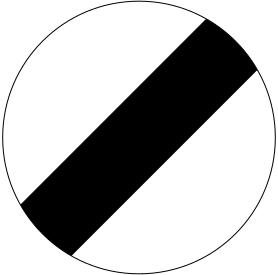
National speed limit
Road sign
National limit for your road and vehicle
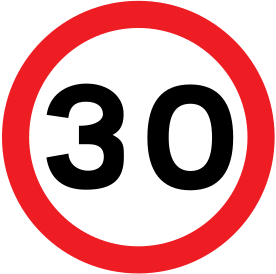
Maximum speed limit
Road sign
A number in a red circle: that limit applies
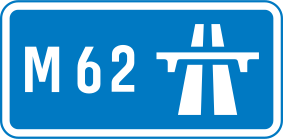
Start of motorway
Road sign
70 mph for cars, unless signed lower
When the limit is lower than 60 or 70
Some vehicles never get 70 mph on a dual carriageway, and a road can have a lower limit set by signs.
Goods vehicles up to 7.5 tonnes laden, and cars towing caravans or trailers, have national limits of 50 mph on single carriageways and 60 mph on dual carriageways. Car-derived vans up to 2 tonnes laden have the same limits as cars.
The Highway Code, Rule 124
Goods vehicles over 7.5 tonnes laden have limits of 50 mph on single carriageways and 60 mph on dual carriageways in England and Wales, and 40 mph and 50 mph in Scotland.
The Highway Code, Rule 124
Local limits may apply, for example 50 mph on single carriageways with known hazards. Variable speed limit signs are used on some motorways and dual carriageways to change the maximum limit.
The Highway Code, Rule 124
A limit, not a target
The national speed limit applies on many narrow country lanes as well as on fast main roads. Being allowed to drive at 60 mph doesn't mean it's safe to.
The speed limit is the absolute maximum and does not mean it is safe to drive at that speed irrespective of conditions. You should reduce your speed when the road layout or condition presents hazards, such as bends, when sharing the road with pedestrians, cyclists and horse riders, in bad weather and at night.
The Highway Code, Rule 125
You must not exceed the maximum speed limits for the road and for your vehicle.
The Highway Code, Rule 124
Test yourself
Check you can tell these signs apart with the Regulatory Signs Quiz: 10 questions, with an explanation after each answer.
Take the Regulatory Signs QuizShare this guide
Pinterest (opens in a new tab)Facebook (opens in a new tab)X (opens in a new tab)WhatsApp (opens in a new tab)EmailSources
- The Highway Code, Rules 124, 125, 135 and 136; Dual carriageways (Rules 137 and 138)
- Know Your Traffic Signs (Department for Transport, Sixth edition, 2023), Speed limit signs, p. 21
- The Traffic Signs Regulations and General Directions 2016, Schedule 1, Part 1 (definitions)
Checked against these sources and reviewed by Bikash Thapa, full UK driving licence holder. Last reviewed 14 October 2026. This guide explains the rules in our own words; for the full rules, see The Highway Code. How we source and check content
More guides
Parking signs and lines: yellow lines, kerb marks and bays
What UK parking lines and signs mean: yellow lines, kerb marks for loading, parking bays, controlled zones, pavement parking and Blue Badge rules.
Smart motorway signs: red X, speed limits and emergency areas
What smart motorway signs mean: a red X closes a lane, a limit in a red circle is mandatory, and when you may use the hard shoulder or an emergency area.
UK speed limits: the national limits and the signs that set them
UK speed limits by road and vehicle: 30 mph in built-up areas (20 mph in Wales), 60 mph on single carriageways and 70 mph on dual carriageways and motorways.
No stopping vs No waiting: what’s the difference?
No waiting lets you stop briefly to load or let passengers out. No stopping means you can’t stop at all. The signs, lines and rules explained.
Stop vs Give way: what’s the difference?
At a Stop sign you must stop at the line every time. At Give way you stop only if you need to. How to tell them apart, and the rules for each.
UK road sign shapes and colours
Circles give orders, triangles warn and rectangles inform. Learn what each UK road sign shape and colour tells you, with examples.