Smart motorway signs: red X, speed limits and emergency areas
On some motorways, overhead signs and signals change to manage traffic: they close lanes, set speed limits and, on some stretches, open the hard shoulder as an extra lane.
This guide explains what each signal means and what the Highway Code says you must do.
By Bikash Thapa, founder and editorPublished
Drafted with AI from the Highway Code and Department for Transport sources, then checked and approved by Bikash Thapa. How we write guides
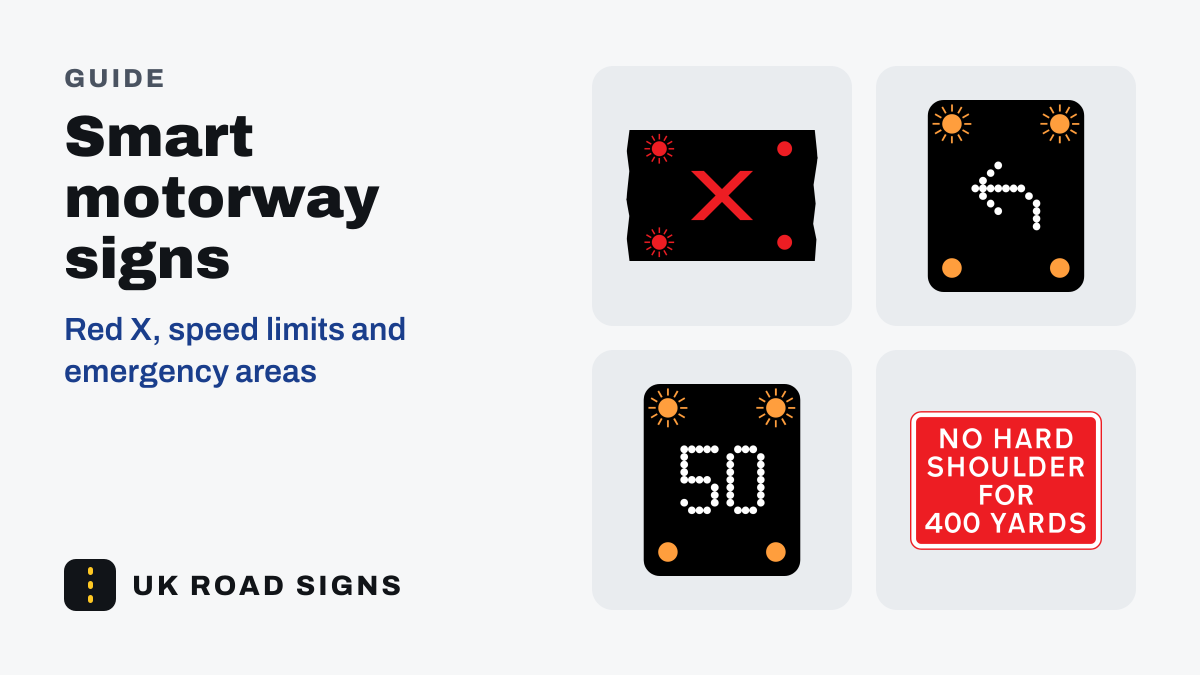
The short version
- A red X, with red flashing lights, means the lane is closed. You must not drive in it.
- A speed limit shown in a red circle is mandatory. A speed shown without a red circle is advice for the conditions.
- Where the hard shoulder can be used as a lane, you may only drive on it when a speed limit is shown above it.
- Emergency areas are marked by blue signs with an orange SOS telephone symbol. Use one if you break down and can reach it.
- If a sign shows all lanes closed, the road is closed: do not go beyond it or use the hard shoulder to get round it.
Red X: a closed lane
A red X is the most important smart motorway signal. It means something is in the lane ahead: a broken-down vehicle, an incident or people working.
Red flashing light signals and a red X on a sign identify a closed lane in which people, stopped vehicles or other hazards are present. You must follow the instructions on signs in advance of a closed lane to move safely to an open lane, and you must not drive in a closed lane.
The Highway Code, Rule 258
A sign will tell you when the lane is no longer closed, by displaying a speed limit or the word END.
The Highway Code, Rule 258
Lane and road closures indicated by red flashing lights are enforced by the police.
The Highway Code, Rule 258
Where red flashing light signals and closure of all lanes are shown on a sign, the road is closed. You must not go beyond the sign in any lane or use the hard shoulder to avoid the closure unless directed to by a police or traffic officer.
Know Your Traffic Signs, p. 105
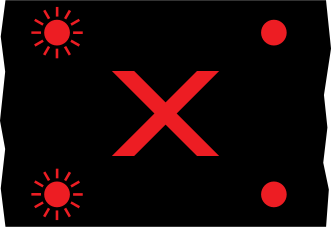
Red X: lane closed
Road sign
Order: do not use this lane
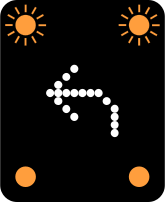
Move to adjacent lane (motorway signal)
Road sign
Move to the lane the arrow shows
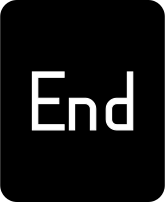
End of restrictions (motorway signal)
Road sign
The restrictions have ended
Variable speed limits
Overhead signs can lower the speed limit to keep traffic moving or to protect people ahead. Look at whether the number has a red circle.
You must not exceed a speed limit displayed within a red circle on a sign.
The Highway Code, Rule 261
Where variable speed limit signs are mounted over individual lanes or at the side of the motorway and the limit is shown in a red circle, the limit is mandatory. Speed limits not shown in a red circle are the maximum speeds advised for the prevailing conditions.
Know Your Traffic Signs, p. 104
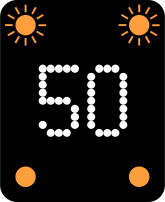
Advised speed (motorway signal)
Road sign
Advised speed: no red circle
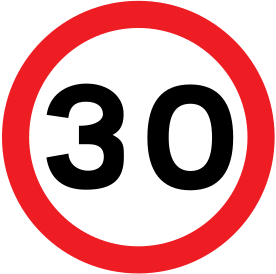
Maximum speed limit
Road sign
A red circle: a legal limit
The hard shoulder as a lane
On some motorways the hard shoulder is opened as an extra lane when traffic is heavy. The signs above it tell you whether you may use it.
Where present, you must not use a hard shoulder except in an emergency or if directed to do so by the police, traffic officers or a traffic sign.
The Highway Code, Rule 269
Where the hard shoulder is used as an extra lane, a red X or a blank sign above it means you must not use it except in an emergency. You can only use it as an extra lane when a speed limit is shown above it.
The Highway Code, Rule 269
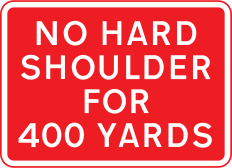
Hard shoulder closed
Road sign
The hard shoulder is closed
Emergency areas and breakdowns
Where there is no hard shoulder, or it is used as a lane, emergency areas give you a safer place to stop.
Where the hard shoulder is being used as an extra lane, emergency areas are provided for use in an emergency. They are marked by blue signs with an orange SOS telephone symbol and may have orange surfacing.
The Highway Code, Rule 269
If you need to stop because of a breakdown or incident, try to stop in a place of relative safety. On motorways and other high-speed roads the safest place to stop is a service area; other places include lay-bys and emergency areas.
The Highway Code, Rule 275
If you cannot get out of your vehicle, or have not stopped near a free emergency telephone, call 999 immediately and ask for the police, or press your SOS button if your vehicle has one.
The Highway Code, Rule 275
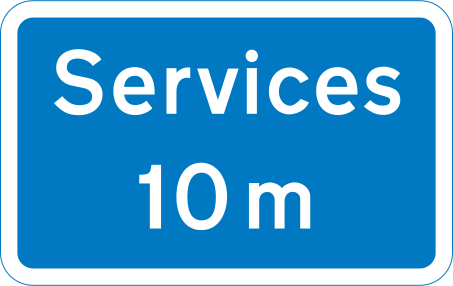
Distance to next services
Road sign
Services are the safest place to stop
Test yourself
Check you can tell these signs apart with the Motorway Signs Quiz: 10 questions, with an explanation after each answer.
Take the Motorway Signs QuizShare this guide
Pinterest (opens in a new tab)Facebook (opens in a new tab)X (opens in a new tab)WhatsApp (opens in a new tab)EmailSources
- The Highway Code, Rules 258, 261, 269 and 275
- Know Your Traffic Signs (Department for Transport, Sixth edition, 2023), Motorway signals and variable signs, pp. 104 to 106
Checked against these sources and reviewed by Bikash Thapa, full UK driving licence holder. Last reviewed 13 October 2026. This guide explains the rules in our own words; for the full rules, see The Highway Code. How we source and check content
More guides
National speed limit: is it 60 or 70?
For cars, the national speed limit is 60 mph on a single carriageway and 70 mph on a dual carriageway. A central reservation, not the lane count, decides which.
Parking signs and lines: yellow lines, kerb marks and bays
What UK parking lines and signs mean: yellow lines, kerb marks for loading, parking bays, controlled zones, pavement parking and Blue Badge rules.
UK speed limits: the national limits and the signs that set them
UK speed limits by road and vehicle: 30 mph in built-up areas (20 mph in Wales), 60 mph on single carriageways and 70 mph on dual carriageways and motorways.
No stopping vs No waiting: what’s the difference?
No waiting lets you stop briefly to load or let passengers out. No stopping means you can’t stop at all. The signs, lines and rules explained.
Stop vs Give way: what’s the difference?
At a Stop sign you must stop at the line every time. At Give way you stop only if you need to. How to tell them apart, and the rules for each.
UK road sign shapes and colours
Circles give orders, triangles warn and rectangles inform. Learn what each UK road sign shape and colour tells you, with examples.