Parking signs and lines: yellow lines, kerb marks and bays
Parking rules in the UK are shown in two ways that work together. Lines and marks on the road tell you that a restriction exists. Plates and signs beside the road tell you when it applies and who it applies to.
This guide explains how to read both, so you can tell where you may park, wait, load or only stop briefly.
By Bikash Thapa, founder and editorPublished
Drafted with AI from the Highway Code and Department for Transport sources, then checked and approved by Bikash Thapa. How we write guides
The short version
- Yellow lines along the kerb control waiting. Double yellow lines mean no waiting at any time; a single yellow line means no waiting at the times on a nearby plate or zone entry sign.
- Yellow marks on the kerb control loading. Two marks mean no loading at any time; one mark means no loading at the times shown on a nearby plate.
- If a plate shows no days, the restriction applies every day, including Sundays and bank holidays.
- White bays show where you may park. The sign by the bay says who may use it, when, and for how long.
- In a controlled parking zone, the times for the yellow lines are on the sign at the zone entrance, not beside each line.
- A street with no lines is not always a legal place to park: you must not cause an obstruction or a danger.
Lines and marks at a glance
| Line or mark | What it means | Where the times are |
|---|---|---|
| Double yellow lines | No waiting at any time | No plate needed: it applies all year |
| Single yellow line | No waiting at certain times | Yellow plate nearby, or the zone entry sign |
| Two yellow marks on the kerb | No loading or unloading at any time | White plate, usually at the first mark |
| One yellow mark on the kerb | No loading or unloading at certain times | White plate, usually at the first mark |
| Double red lines | No stopping at any time (red routes) | Upright signs might not be provided |
| Single red line | No stopping at certain times (red routes) | Upright sign facing oncoming traffic |
| White bay markings | A parking or loading place | Upright sign at the bay |
Know Your Traffic Signs, pp. 44 to 66
Yellow lines: waiting restrictions
Yellow lines run along the edge of the road, parallel to the kerb. They stop you waiting or parking, but they still let you make a short stop.
A single yellow line on its own does not tell you the times. Look for the small yellow plate nearby, or remember the times from the zone entry sign.
Waiting restrictions indicated by yellow lines apply to the carriageway, pavement and verge. You may stop to load or unload (unless there are also loading restrictions) or while passengers board or alight.
The Highway Code, Road markings
You must not wait or park on yellow lines during the times of operation shown on nearby time plates, or on zone entry signs in a controlled parking zone. Double yellow lines indicate a prohibition of waiting at any time, even if there are no upright signs.
The Highway Code, Rule 238
Where the yellow plate does not show the days of the week, the restrictions apply at the same times every day, including Sunday. If a bank holiday falls on a day when they operate, they apply in the normal way unless the plate says they do not.
Know Your Traffic Signs, p. 44
A double yellow line means no waiting at any time throughout the year. There is normally no yellow plate, except where an older double line remains that applies for only part of the year.
Know Your Traffic Signs, p. 45
Red and single yellow lines can only give a guide to the restrictions in force. You must check the signs nearby or at the zone entry.
The Highway Code, Road markings
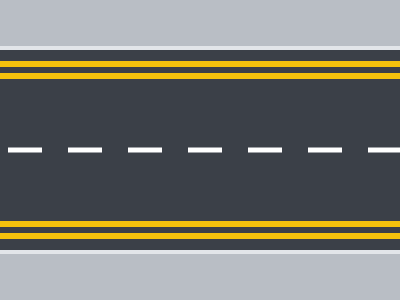
Double yellow lines
Road marking
No waiting at any time
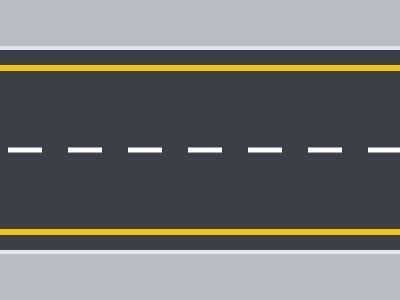
Single yellow line
Road marking
No waiting at the times on the plate
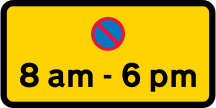
No waiting
Road sign
The no waiting symbol used on plates
Yellow kerb marks: loading restrictions
Short yellow marks painted across the kerb are a separate rule from the yellow lines. They control loading and unloading, and they can apply where there are no yellow lines at all.
The times are on white plates. One plate often shows both rules: a yellow panel for waiting and a white panel for loading.
Yellow marks on the kerb or at the edge of the carriageway mean loading or unloading is prohibited at the times shown on the nearby black and white plates. You may stop while passengers board or alight.
The Highway Code, Road markings
A double kerb mark means no loading at any time and is normally supplemented by a No loading at any time plate. A single kerb mark means loading is prohibited during the times shown on the plate.
Know Your Traffic Signs, p. 46
The marks are placed at intervals along the kerb, so a white plate is normally put up at the first mark, where the restriction begins. It may include an arrow showing the direction along the road in which the restriction applies.
Know Your Traffic Signs, p. 45
On a combined plate, an arrow applies only to the panel it is placed on, not to the whole plate.
Know Your Traffic Signs, p. 48
Do not load or unload where there are yellow markings on the kerb and upright signs advise restrictions are in place.
The Highway Code, Rule 247
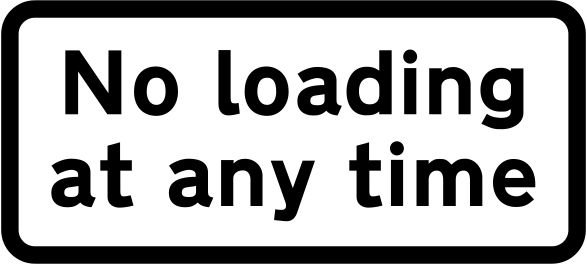
No loading at any time
Road sign
Goes with two marks on the kerb
Parking bays and their signs
White bay markings show where you may park, but not on what terms. Always read the upright sign by the bay: one bay can have different rules at different times of day.
On-street parking places may be reserved for a class of vehicle, such as solo motorcycles, or a type of user, such as permit holders or disabled badge holders. Parking may be free or paid for, and there may be a time limit and a minimum time before you can return.
Know Your Traffic Signs, p. 50
Where a parking sign does not show the days of the week, the controls apply every day, including Sunday. Where it does not show the time of day, the controls apply for 24 hours.
Know Your Traffic Signs, p. 50
Where parking-place controls do not operate at all times, any vehicle may park in the bay without payment or time limit outside those times, unless the signs show other restrictions.
Know Your Traffic Signs, p. 56
You must not park in parking spaces reserved for specific users, such as Blue Badge holders, residents or motorcycles, unless you are entitled to.
The Highway Code, Rule 241
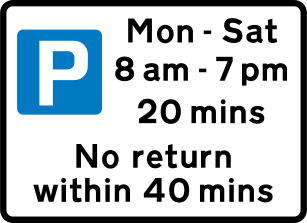
Parking with time limit
Road sign
Free parking, with a time limit
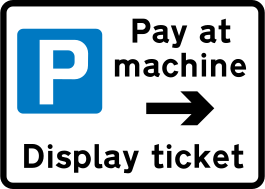
Pay and display parking
Road sign
Pay at the machine
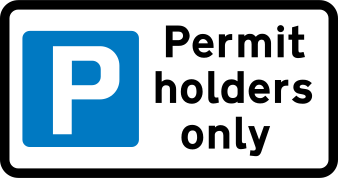
Permit holders only parking
Road sign
Permit holders only
Loading bays
A loading bay is not a short-stay parking space. You may only use it while you are actually loading or unloading.
Loading bays are marked with a white bay and the words Loading Only, with a sign showing a white trolley on blue. The sign shows whether the bay is only for goods vehicles and when it can be used. If no times or days are shown, it may be used at any time. Vehicles may not park there if they are not loading or unloading.
The Highway Code, Road markings
Loading bays outside shops are for collecting pre-paid items that are too large or heavy to carry to where the car is parked, not for use before making the purchase. Once loading is complete, the vehicle must leave the bay.
Know Your Traffic Signs, p. 59
Some bays are used for loading at some times of day and for other users, such as disabled badge holders, at others. These bays are not marked LOADING ONLY, so read the upright sign.
Know Your Traffic Signs, p. 59
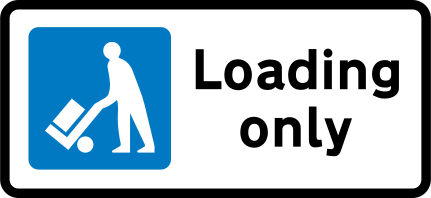
Loading only
Road sign
Loading and unloading only
Controlled parking zones and other zones
In a zone, one sign at the entrance sets the rules for every street inside, so the usual plates beside the lines are left out. Note the times as you drive in.
In a controlled parking zone, the zone entry signs show the times when the waiting restrictions inside the zone are in force. Otherwise, parking is in separately signed and marked bays.
The Highway Code, Rule 245
The yellow lines inside a controlled parking zone do not normally have yellow plates unless their times differ from the entry sign. If the entry sign has no lower panel showing days and times, the zone operates at all times.
Know Your Traffic Signs, p. 61
The times for parking bays inside the zone are shown on signs at the bays and may not be the same as those on the zone entry sign.
Know Your Traffic Signs, p. 61
The zone sign may be headed Pay and Display ZONE, Meter ZONE or Disc ZONE. In a disc zone, you must display a parking disc showing your time of arrival.
Know Your Traffic Signs, pp. 61 and 62
In a restricted parking zone, used in some environmentally sensitive areas, uniform waiting and loading restrictions are shown by upright repeater signs instead of yellow lines and kerb marks.
Know Your Traffic Signs, p. 63
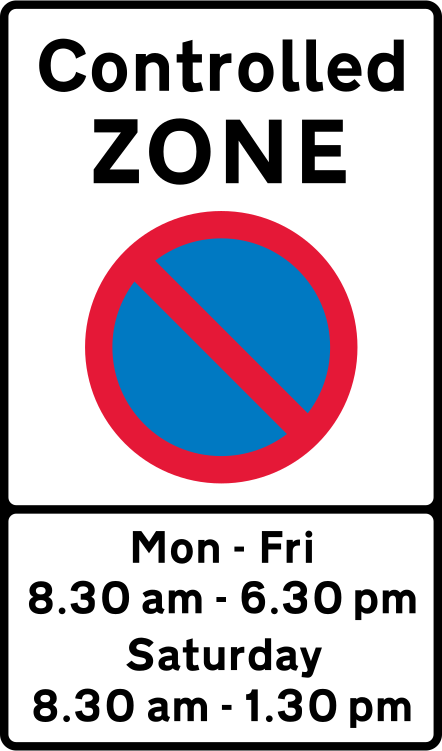
Controlled parking zone
Road sign
Entering the zone: note the times
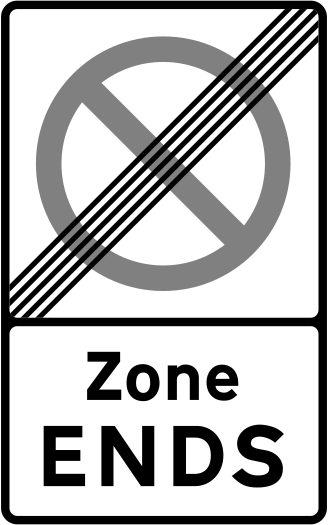
Zone ends
Road sign
Leaving the zone
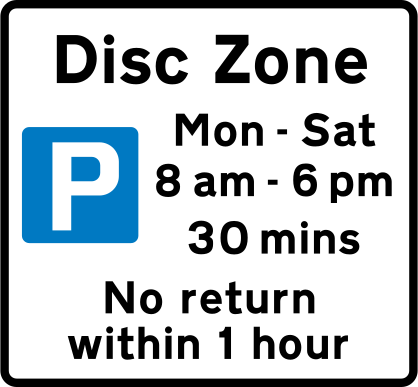
Disc zone
Road sign
Display a parking disc
Parking on the pavement
Pavement parking is banned outright in London and Scotland. Elsewhere, the Highway Code says not to do it unless a sign allows it.
You must not park partially or wholly on the pavement in London or Scotland, except in limited circumstances. You should not park partially or wholly on the pavement elsewhere unless signs permit it.
The Highway Code, Rule 244
Footway parking may be allowed on some narrow streets where parked vehicles would not obstruct pedestrians. Special signs show this, and white bays may show where parking is permitted.
Know Your Traffic Signs, p. 58
Vehicles with a maximum laden weight of over 7.5 tonnes, including any trailer, must not be parked on a verge, pavement or land between carriageways without police permission, except when essential for loading and unloading, and then they must not be left unattended.
The Highway Code, Rule 246
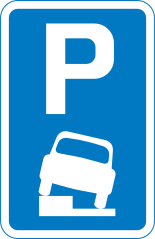
Parking partly on verge or footway
Road sign
Partly on the pavement is allowed
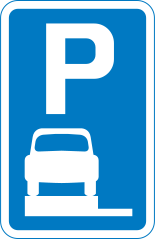
Parking wholly on verge or footway
Road sign
Wholly on the pavement is allowed
Blue Badge holders
A Blue Badge gives extra parking concessions, but it is not a licence to park anywhere. The rules below are for England; Scotland and central London are different.
Badge holders may park on single or double yellow lines for up to 3 hours, but in general not where there are loading restrictions shown by yellow kerb marks or plates. They must display the badge and the blue parking clock set to the quarter hour they arrived.
The Blue Badge scheme: rights and responsibilities in England, Parking concessions: yellow lines
Badge holders may not park on yellow lines in off-street car parks, and must check local rules where local schemes apply, such as in parts of central London.
The Blue Badge scheme: rights and responsibilities in England, Parking concessions: yellow lines
The Blue Badge scheme does not fully apply in the City of Westminster, the City of London, the Royal Borough of Kensington and Chelsea and part of the London Borough of Camden. These boroughs run their own concessions.
The Blue Badge scheme: rights and responsibilities in England, Parking in central London
In Scotland, disabled badge holders can usually park on yellow lines without a time limit.
Know Your Traffic Signs, p. 44
On red routes, the driver of a vehicle displaying a disabled badge may stop to pick up or set down a disabled person, but must not park.
Know Your Traffic Signs, p. 66
Red routes
On red routes, red lines replace yellow lines and ban stopping, not just waiting. Our No stopping vs No waiting guide covers them in more detail.
Red lines apply to the carriageway, pavement and verge. The double red line always means no stopping at any time.
The Highway Code, Road markings
On red routes you may park or load in specially marked boxes, and the signs beside them give the times, purposes and duration allowed. A box marked in red may only be available for its purpose for part of the day; a box marked in white is available throughout the day.
The Highway Code, Road markings
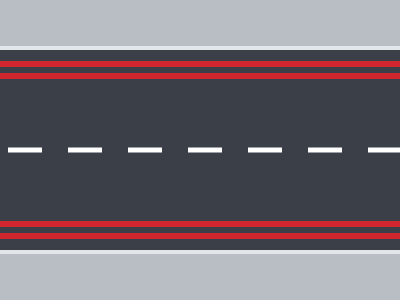
Double red lines
Road marking
No stopping at any time
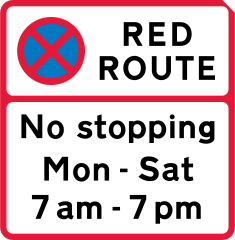
Red route: no stopping at times shown
Road sign
No stopping at the times shown
No lines? Check before you park
Lines and signs do not cover every place where parking is unsafe. The Highway Code lists places to avoid even when the road is unmarked.
You must not leave your vehicle or trailer in a dangerous position or where it causes any unnecessary obstruction of the road.
The Highway Code, Rule 242
Do not stop or park opposite or within 10 metres (32 feet) of a junction, except in an authorised parking space; near a school entrance; at or near a bus or tram stop or taxi rank; on a bend; near the brow of a hill or a hump bridge; in front of an entrance to a property; or where the kerb has been lowered to help wheelchair users.
The Highway Code, Rule 243
You must not wait or park, or stop to set down and pick up passengers, on school entrance markings when upright signs show a prohibition of stopping.
The Highway Code, Rule 238
You must not stop or park on a pedestrian crossing, including the area marked by the zig-zag lines.
The Highway Code, Rule 240
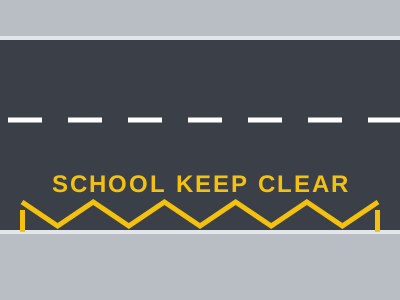
School keep clear markings
Road marking
Keep clear, even to drop off children
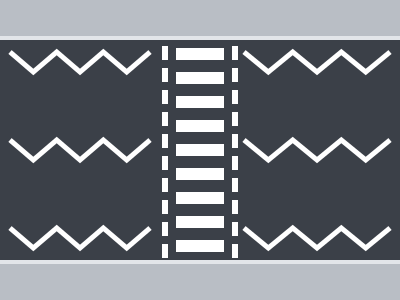
Zig-zag lines at crossings
Road marking
No stopping or parking at a crossing
Test yourself
Check you can tell these signs apart with the Road Markings Quiz: 10 questions, with an explanation after each answer.
Take the Road Markings QuizShare this guide
Pinterest (opens in a new tab)Facebook (opens in a new tab)X (opens in a new tab)WhatsApp (opens in a new tab)EmailSources
- Know Your Traffic Signs (Department for Transport, Sixth edition, 2023), On-street parking control signs and road markings, pp. 44 to 66
- The Highway Code, Rules 238 to 247
- The Highway Code, Road markings
- The Blue Badge scheme: rights and responsibilities in England (Department for Transport, Updated 9 July 2020), Parking concessions and Parking in central London
Checked against these sources and reviewed by Bikash Thapa, full UK driving licence holder. Last reviewed 14 October 2026. This guide explains the rules in our own words; for the full rules, see The Highway Code. How we source and check content
More guides
National speed limit: is it 60 or 70?
For cars, the national speed limit is 60 mph on a single carriageway and 70 mph on a dual carriageway. A central reservation, not the lane count, decides which.
Smart motorway signs: red X, speed limits and emergency areas
What smart motorway signs mean: a red X closes a lane, a limit in a red circle is mandatory, and when you may use the hard shoulder or an emergency area.
UK speed limits: the national limits and the signs that set them
UK speed limits by road and vehicle: 30 mph in built-up areas (20 mph in Wales), 60 mph on single carriageways and 70 mph on dual carriageways and motorways.
No stopping vs No waiting: what’s the difference?
No waiting lets you stop briefly to load or let passengers out. No stopping means you can’t stop at all. The signs, lines and rules explained.
Stop vs Give way: what’s the difference?
At a Stop sign you must stop at the line every time. At Give way you stop only if you need to. How to tell them apart, and the rules for each.
UK road sign shapes and colours
Circles give orders, triangles warn and rectangles inform. Learn what each UK road sign shape and colour tells you, with examples.