Regulatory sign
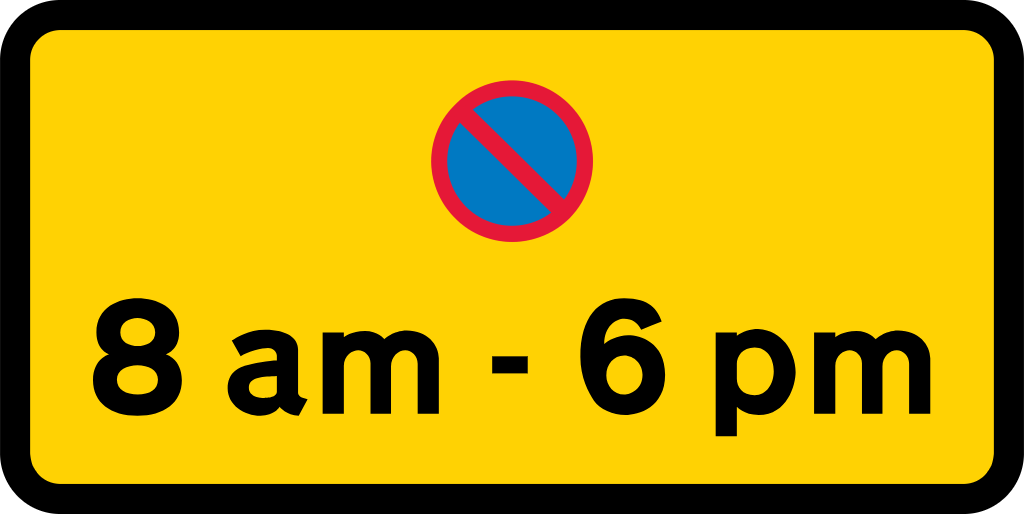
No waiting sign
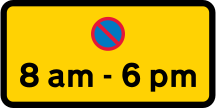
What does the No waiting sign mean?
You must not wait or park here during the times shown. The plate goes with the yellow lines along the edge of the road.
Also known as: Waiting restriction sign, Yellow line time plate
What it means
Yellow lines along the edge of the road show a waiting restriction, and this plate tells you when it applies. Outside the times shown, this restriction doesn't apply, although other restrictions might.
The symbol is a blue circle with a red border and one red diagonal line. On its own, without times, it is used on portable signs to mark temporary waiting restrictions.
Read the plate carefully. If it doesn't list days of the week, the restriction applies at the same times every day, including Sunday. It still applies on a bank holiday unless the plate says it doesn't.
Loading restrictions are shown separately, by yellow marks on the kerb and white plates. These may be combined with the yellow no waiting plate.
What the symbol shows
The small blue circle crossed by one red diagonal line is the 'no waiting' symbol. The times underneath tell you when the restriction applies.
Memory tip: One line: don't wait. Two lines, a cross: don't stop at all.
Where you'll see it
On posts or walls beside roads with yellow lines where waiting is restricted at certain times. Double yellow lines mean no waiting at any time and normally have no plate.
Rules to know
You must not wait or park on yellow lines during the times of operation shown on nearby time plates, or on zone entry signs in a controlled parking zone.
The Highway Code, Rule 238
Where the plate does not show days of the week, the restrictions apply at the same times every day, including Sunday.
Know Your Traffic Signs, p. 44
If a bank holiday falls on a day when the restrictions operate, they apply in the normal way unless the plate says otherwise.
Know Your Traffic Signs, p. 44
Double yellow lines mean no waiting at any time throughout the year, normally without a plate.
Know Your Traffic Signs, p. 45
Spot the difference
No waiting vs No stopping (clearway)
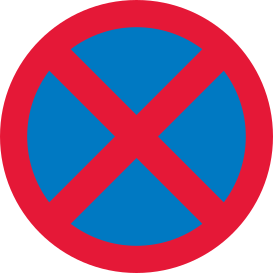
The key difference: A red cross means no stopping on a clearway. A single red diagonal line means waiting is restricted during the times shown.
| No waiting | No stopping (clearway) | |
|---|---|---|
| Symbol | One red diagonal line, usually on a yellow plate | Red cross |
| When it applies | During the times shown | At any time (24-hour clearway) |
| Road markings | Yellow lines along the kerb | None: the signs tell you |
Know Your Traffic Signs, On-street parking control, pp. 44 and 64
Common mistakes
Mistake: Assuming the restriction only applies on weekdays.
Instead: If the plate doesn't show any days, it applies every day, including Sunday.
Mistake: Confusing it with the No stopping (clearway) sign.
Instead: No waiting has one red diagonal line and applies at the times shown. The clearway sign has a red cross and bans stopping on the main carriageway altogether.
Test yourself
Recalling the answer helps it stick. Pick an answer to see how you did.
Question 1 of 2
What does this sign mean?
Full road sign quizzes are coming soon. See what's planned
Download this sign
© Crown copyright. Free to reuse under the Open Government Licence v3.0, as long as the sign is reproduced accurately and not in a misleading context.
Related signs
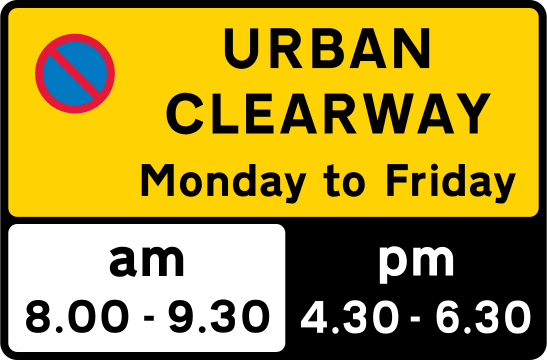
See also
Urban clearway
Regulatory sign
No stopping at the times shown, except to pick up or drop off.
Often confused with
No stopping (clearway)
Regulatory sign
A red cross, not one line: no stopping at all on a clearway.
More regulatory signs
All regulatory signs
Sources
- Know Your Traffic Signs (Department for Transport, Sixth edition, 2023), On-street parking control, pp. 44–45
- The Highway Code, Rule 238
Sign image: Department for Transport, Traffic sign images (diagram 639). © Crown copyright, reused under the Open Government Licence v3.0.
Checked against these sources and reviewed by Bikash Thapa, full UK driving licence holder. Last reviewed 4 October 2026. This page explains the sign in our own words; for the full rules, see The Highway Code. How we source and check content