Regulatory sign
National speed limit sign
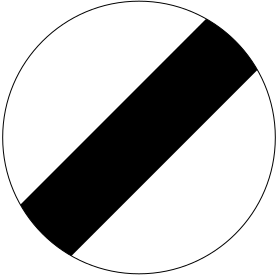
What does the National speed limit sign mean?
The national speed limit applies. For cars and motorcycles that's 60 mph on single carriageways and 70 mph on dual carriageways.
Also known as: NSL sign, White circle with black stripe
What it means
The speed limit is the national limit for the type of road and the type of vehicle you're driving, rather than a number shown on the sign.
For cars and motorcycles, the national limit is 60 mph on a single carriageway and 70 mph on a dual carriageway or motorway. Lower limits apply to some vehicles, such as those towing a caravan or trailer, and goods vehicles.
It's a maximum, not a target. On a narrow country lane where the national limit applies, a safe speed may be far lower.
Smaller repeater signs remind you of the limit. National speed limit repeaters are only used on roads with street lighting, where you might otherwise assume a 30 mph limit.
What the symbol shows
There's no number on this sign. The black diagonal band tells you the national limit applies, so the number depends on the type of road and your vehicle.
Memory tip: No number on the sign? Then the number depends on the road and your vehicle.
Where you'll see it
Where a lower speed limit ends, for example as you leave a town or village, and as repeater signs along roads with street lighting.
Rules to know
The sign means the national speed limit for the type of road and class of traffic applies.
Know Your Traffic Signs, p. 21
You must not exceed the maximum speed limits for the road and for your vehicle.
The Highway Code, Rule 124
Don't treat speed limits as a target. It is often not appropriate or safe to drive at the maximum speed limit.
The Highway Code, Rule 146
| Vehicle | Single carriageway | Dual carriageway | Motorway |
|---|---|---|---|
| Cars, motorcycles and car-derived vans (up to 2 tonnes laden) | 60 | 70 | 70 |
| Cars towing caravans or trailers | 50 | 60 | 60 |
| Motorhomes up to 3.05 tonnes | 60 | 70 | 70 |
| Motorhomes over 3.05 tonnes | 50 | 60 | 70 |
| Buses, coaches and minibuses up to 12 m | 50 | 60 | 70 |
| Goods vehicles up to 7.5 tonnes | 50 | 60 | 70 (60 if articulated or towing) |
| Goods vehicles over 7.5 tonnes (England and Wales) | 50 | 60 | 60 |
| Goods vehicles over 7.5 tonnes (Scotland) | 40 | 50 | 60 |
What happens if you ignore it
The minimum penalty for speeding is a £100 fine and 3 penalty points on your licence.
Speeding penalties, Speeding penalties
If the case goes to court, the fine is usually a percentage of your weekly income, up to £1,000 (£2,500 on a motorway).
Speeding penalties, Speeding penalties
Exceeding the statutory speed limit on a public road carries 3 to 6 penalty points (endorsement code SP30).
Penalty points (endorsements): endorsement codes and penalty points, Endorsement code SP30
General information, not legal advice. Enforcement can differ between areas.
Common mistakes
Mistake: Thinking the sign means there's no speed limit.
Instead: It means the national speed limit applies: for cars, 60 mph on single carriageways and 70 mph on dual carriageways and motorways.
Mistake: Thinking it always means 70 mph.
Instead: 70 mph is for dual carriageways and motorways. On a single carriageway the national limit for cars is 60 mph.
Test yourself
Recalling the answer helps it stick. Pick an answer to see how you did.
Question 1 of 1
What does this sign mean?
Full road sign quizzes are coming soon. See what's planned
Download this sign
© Crown copyright. Free to reuse under the Open Government Licence v3.0, as long as the sign is reproduced accurately and not in a misleading context.
Related signs
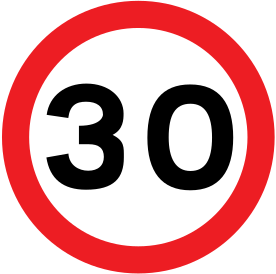
Similar
Maximum speed limit
Regulatory sign
A specific limit, shown as a number in a red ring.
More regulatory signs
All regulatory signs

Sources
- Know Your Traffic Signs (Department for Transport, Sixth edition, 2023), Speed limit signs, p. 21
- The Highway Code, Rules 124 and 146
Sign image: Department for Transport, Traffic sign images (diagram 671). © Crown copyright, reused under the Open Government Licence v3.0.
Checked against these sources and reviewed by Bikash Thapa, full UK driving licence holder. Last reviewed 4 October 2026. This page explains the sign in our own words; for the full rules, see The Highway Code. How we source and check content