Road marking
Double white lines
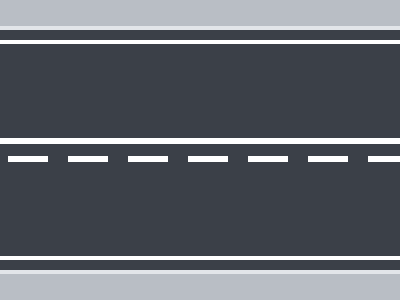
What do double white lines mean?
If the line nearer you is solid, you must not cross or straddle it, except in a few cases. If it is broken, you may cross to overtake.
What it means
Double white lines control overtaking. The line on your side tells you what you may do.
Where the line nearer to you is broken, you may cross the lines to overtake if it is safe and you can get back before a solid line on your side.
Where the line nearer to you is solid, you must not cross or straddle it, except to turn into a side road or property, to pass a stationary vehicle, or to overtake a cycle, horse or road works vehicle going at 10 mph or less.
You must not stop on a road with double white lines, even if the line on your side is broken, except to pick up or set down passengers or to load or unload.
Tip: Read the line nearest you: solid means stay, broken means you may cross if safe.
Where you'll see it
Where it is dangerous to overtake, such as on bends, near the brow of a hill, and on hills with climbing lanes.
Rules to know
Where the line nearer to you is solid, you must not cross or straddle it unless it is safe and you need to enter adjoining premises or a side road.
The Highway Code, Rule 129
You may cross a solid line, if the road is clear, to pass a stationary vehicle or overtake a pedal cycle, horse or road maintenance vehicle travelling at 10 mph or less.
The Highway Code, Rule 129
Where the line nearer to you is broken, you may cross the lines to overtake if it is safe, provided you can complete it before reaching a solid white line on your side.
The Highway Code, Rule 128
You must not stop or park on a road marked with double white lines, even when a broken line is on your side, except to pick up or set down passengers, or to load or unload goods.
The Highway Code, Rule 240
Common mistakes
Mistake: Thinking a broken line on your side means you may park there.
Instead: You must not stop on any road with double white lines, except to pick up or set down passengers or to load or unload.
Mistake: Crossing the solid line to overtake a slow car.
Instead: Only a cycle, horse or road works vehicle going at 10 mph or less may be passed that way.
Test yourself
Recalling the answer helps it stick. Pick an answer to see how you did.
Question 1 of 1
What does this marking mean?
Ready for more? Take the Road Markings Quiz
Related markings and signs
See also
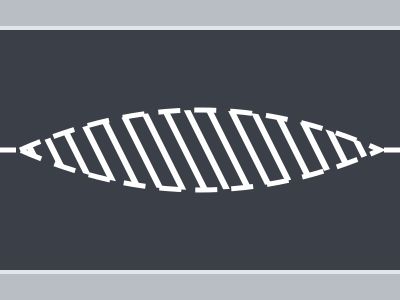
Hatched markings
Road marking
Diagonal stripes that separate traffic.
Similar
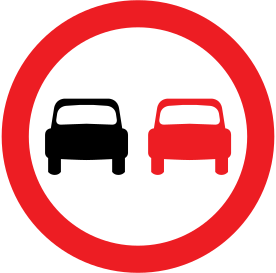
No overtaking
Road sign
A sign that bans overtaking.
More road markings
All road markings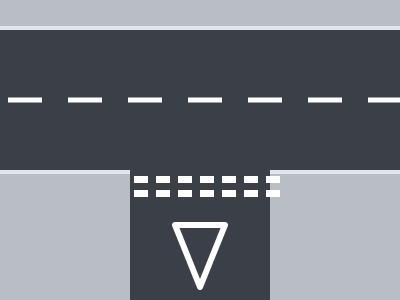
Sources
- The Highway Code, Road markings
- The Highway Code, Rule 128
- The Highway Code, Rule 129
- Know Your Traffic Signs (Department for Transport, Sixth edition, 2023), Road markings, p. 76
The diagram is our own illustration of the marking, not to scale. Official drawings are in Know Your Traffic Signs and the Highway Code.
Last reviewed 6 October 2026. This page explains the marking in our own words; for the full rules, see The Highway Code. How we source and check content